- Home

How Many Recline Positions Should an Outdoor Sun Lounger Have?
Views: 0 Author: Site Editor Publish Time: 2026-11-23 Origin: Site


Imagine stepping onto your patio with a fresh cup of coffee. You are ready to sink into a personal backyard resort. Creating this restorative environment requires careful furniture selection. Yet, finding the perfect seating often brings unexpected confusion. Buyers frequently face a mechanical dilemma. How many backrest angles do you actually need? Is a basic three-position setup enough? Or is a six-position model strictly necessary for proper spinal support?
The ideal configuration depends entirely on your daily routine. Whether your afternoon involves reading a novel, taking a quick nap, or actively socializing, the functionality of your furniture must match your physical requirements. In this comprehensive guide, we will break down standard recline angles from an engineering perspective. You will learn the mechanics behind different hinges and the critical load-bearing specifications to review before your next outdoor seating investment.
Key Takeaways
The Ergonomic Sweet Spot: Premium outdoor sun loungers incorporate between four to six recline positions. This ensures a complete spectrum of postural support from seated upright to completely flat.
Function Dictates Form: Upright angles facilitate reading and dining. Deeper recline angles are engineered for resting. A fully flat configuration remains essential for prone sunbathing.
Mechanism Quality Matters: The structural integrity of the reclining hardware supersedes the sheer number of available positions.
Location Parameters: A poolside environment typically demands lay-flat capabilities. A garden setting may prioritize upright seating versatility instead.
Industry Trends: The Shift Toward Micro-Adjustability
Recent market analysis of outdoor living spaces reveals a distinct shift in consumer behavior. Homeowners no longer view patios as simple backyards. They treat these spaces as wellness-focused extensions of their indoor living rooms. Consequently, manufacturing standards have evolved significantly. The industry standard for a premium adjustable outdoor sun lounger now typically dictates four, five, or six distinct positions. This standardization is deeply rooted in human biomechanics rather than arbitrary design choices.
We see a rapid departure from basic two-position folding frames. Modern designs prioritize micro-adjustability and structural alignment. However, adding too many adjustment notches actually weakens the main load-bearing frame. Therefore, structural engineers focus on perfecting the five-position or six-position model. This strikes the perfect balance between ergonomic comfort and long-term frame integrity.
Fewer than three positions severely limit functionality. A chair with only two options forces a user to choose between sitting rigidly upright or lying entirely flat. You miss the comfortable intermediate angles necessary for casual relaxation. Furthermore, buyers should actively verify the existence of the zero position. This refers to the fully flat baseline. Not all loungers offer a true lay-flat option due to fixed ergonomic curves in the leg rest. Establishing whether a chair can achieve this zero position is a critical first step in the purchasing process.
Decoding the Angles: The Biomechanics of Reclining
Understanding the specific utility of each angle helps you visualize your needs. This ensures your chosen furniture matches your physical requirements perfectly. Let us look at the standard recline angles and their primary ergonomic functions.
Position 1: The Upright Angle
The steepest setting on a frame is engineered for active engagement. It provides firm lumbar and cervical support. This 70 to 80-degree angle is optimal for reading a heavy hardcover book. You can balance a morning espresso easily. It keeps the spine aligned. This prevents the neck strain that inevitably occurs when trying to look forward while leaning too far back.Position 2 and 3: The Gentle Slopes
Empirical data suggests these intermediate angles represent the most frequently utilized positions. A 45 to 60-degree slope facilitates a neutral body posture. It reduces muscle tension while keeping the head elevated. This setting is ideal for casual lounging or enjoying a scenic landscape. It strikes the perfect balance between deep relaxation and environmental awareness.Position 4 and 5: The Deep Recline
When the backrest drops to 20 or 30 degrees, the body enters a state of restorative rest. This deep recline shifts your center of gravity. It evenly distributes body weight across the frame. Specifically, it significantly relieves pressure on the lower lumbar region and promotes better blood circulation in the legs. These positions are tailored for afternoon naps or stargazing.Position 6: Completely Flat
Achieving a 180-degree horizontal plane transforms the chair into a flat bed. This angle is essential for individuals who wish to tan evenly on both their back and stomach. Beyond sunbathing, a completely flat profile allows for comfortable prone sleeping.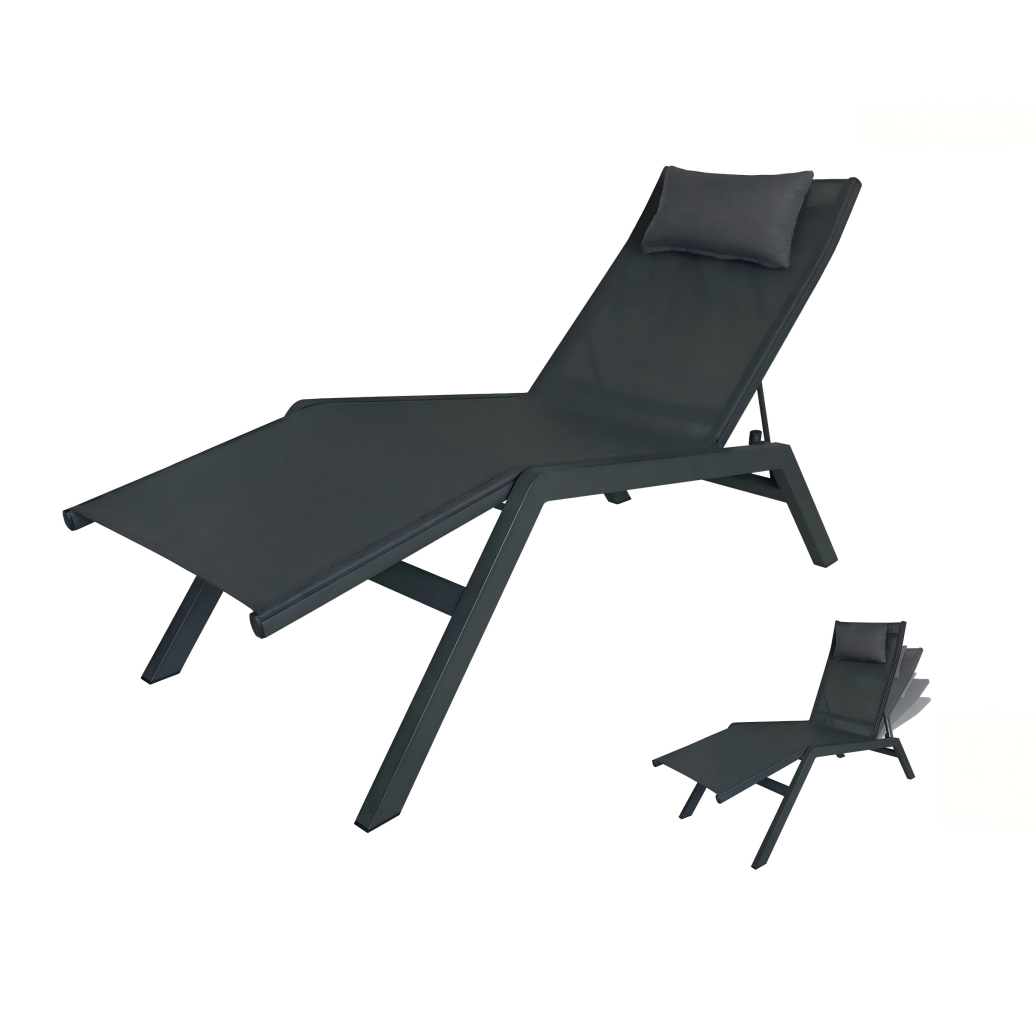
Why the Lay-Flat Feature is Crucial for a Poolside Environment
When outfitting a pool deck, environmental demands make the completely flat feature an operational necessity. It is not merely a luxury. A dedicated poolside sun lounger serves distinct purposes that differ heavily from standard patio dining sets.
Achieving an even tan requires the ability to lie comfortably face down. If a frame stops at a 20-degree angle, lying on your stomach forces your spine into a painful arch. A true 180-degree flat surface ensures optimal spinal alignment for prone resting.
Safety plays a massive role in this specific environment. Pool decks are inherently wet and slippery with splashing water. A frame locked into a completely flat position provides a stable platform. This makes mounting and dismounting much safer for individuals with limited mobility. There is no angled backrest to navigate around or accidentally lean heavily against.
From a logistical standpoint, stackability matters immensely. Loungers capable of lying completely flat are almost always designed to stack neatly. This architectural feature saves immense storage space during winter months in a cramped shed or garage.
Fixed vs. Adjustable: Engineering the Right Choice for Your Space
The decision between a fixed-angle chair and a multi-position model dictates how your space will function. Both structural designs offer distinct advantages based on their intended application.
Fixed frames are manufactured with a static backrest angle. They often mimic a wave-like curve. The primary advantage here is raw structural integrity. With zero moving parts or hinges, there is virtually nothing to break over time. They feature sleek architectural lines. However, this design forces you into one continuous posture. This can become uncomfortable over extended periods and is terrible for tasks like reading.
In contrast, a premium garden reclining lounger offers the versatility required for multi-functional spaces. A single piece of furniture might serve as a morning coffee spot and an evening stargazing bed. Adjustable options adapt seamlessly to changing physical needs throughout the day.
Mechanism Types: An Engineer's Look at Lounger Hardware
The longevity of an outdoor chaise lounger depends heavily on its reclining mechanism. Evaluating the underlying hardware allows you to assess the true value of your investment.
Notched Track Systems
This is the most traditional adjustment mechanism. It features a visible track with cut-out slots. It is mechanically simple and visually intuitive. Users can easily see which angle they are selecting. However, if the track is made from low-grade plastic, intense UV exposure causes embrittlement. The notch edges can wear down and cause the backrest to slip unexpectedly.Ratchet and Click-Clack Mechanisms
These rely on internal toothed hinges. As you pull the backrest forward, the gear clicks into preset locks. This offers a remarkably clean aesthetic because the hardware is hidden. Unfortunately, internal gears are highly susceptible to rust if not perfectly sealed against moisture. If a single gear tooth shears off under pressure, the entire function fails permanently.Gas Piston Systems
Found in luxury commercial-grade models, these operate similarly to premium office chairs. A lever releases a pressurized cylinder. This provides seamless adjustments without preset notches. It delivers customized ergonomic comfort. The downside is the significantly higher price point and the need for meticulous maintenance to protect the piston seals from temperature fluctuations.Mechanism Type
Durability & Lifespan
Maintenance Required
Cost Implication
Notched Track
High if made of aluminum. Low if plastic.
Low. Just keep tracks clear of debris.
Economical
Ratchet Hinge
Moderate. Prone to internal rust.
Medium. Requires internal lubrication.
Moderate
Gas Piston
Very High. Commercial grade.
High. Must protect seals from extreme weather.
Premium
Buyer’s Guide: Critical Specs for Your Next Investment
Evaluating secondary features ensures a durable, frustration-free purchase. Let us look at the specific parameters you should demand from manufacturers.
Hardware Material and Frame Thickness
The frame is only as robust as its weakest joint. Insist on rust-proof powder-coated aluminum. Standard steel hardware will quickly oxidize in humid environments. High-end models utilize 1.2mm to 1.5mm thick aluminum tubes. This specific thickness prevents the frame from bending under sheer stress while remaining lightweight enough to move easily.Weight Capacity at Angles
The physics of a reclining backrest dictate that mechanical stress increases exponentially the further back you lean. An upright backrest transfers weight straight down into the legs. A backrest reclined to 30 degrees acts as a lever. It applies massive torque to the primary hinge. Always verify that the frame supports at least 120kg to 150kg evenly distributed in its lowest angled position.Fabric Tension and Breathability
The sling material matters just as much as the metal. Premium textilene mesh provides high tensile strength and superior UV resistance. It conforms to the body ergonomically while allowing pool water and rain to drain instantly. This prevents the sagging commonly seen in cheaper polyester blends.Top Maintenance Tips for Reclining Hardware
Proper maintenance extends the operational lifespan of your seating. It ensures smooth and safe operation year after year.
Routine Cleaning
Accumulated debris is the most common cause of hinge failure. Regularly clear the adjustment tracks. Leaves, abrasive sand, or dirt act as a grinding compound. This accelerates the wear of notches and hinges. A quick blast of compressed air works wonders.Proper Lubrication
Metal hinges require seasonal lubrication to prevent binding. Apply a dry PTFE-based lubricant annually. Avoid standard wet oil formulas. Wet oils actively attract airborne dust and create a destructive paste inside the joint.Winterizing Protocols
Always leave the frame in the completely flat position when preparing for off-season storage. Leaving a chair locked upright maintains constant static tension on internal springs or gears. Storing it flat relieves all mechanical stress. This simple step prevents premature metal fatigue during months of inactivity.Conclusion
The quality of your recline mechanism matters just as much as the sheer number of angles provided. Four to six positions represent the gold standard for proper postural support. Your specific lifestyle should dictate your final purchase. Dedicated sunbathers must prioritize a fully flat option to ensure even tanning. Those creating an outdoor reading room should focus on a sturdy upright lock. By assessing your daily activities and demanding high-quality aluminum hardware, you can confidently select the right seating. Ready to upgrade your patio? Explore the premium collection of engineered outdoor furniture at Alpha Garden to find the perfect match for your backyard sanctuary.
FAQ
Can all outdoor sun loungers lay completely flat?
No. While many models offer this highly requested feature, several incorporate a permanent ergonomic curve designed for knee and lumbar support. This fixed geometry prevents a true 180-degree flat position. Always verify the exact product specifications if prone lounging is a requirement for you.
Is a 3-position outdoor chair enough?
For casual use, three positions may suffice. However, a three-position model typically forces a compromise. You sacrifice either a strict reading angle or a completely flat resting angle. Four to six positions provide vastly superior ergonomic versatility.
How do I fix a broken recline notch?
Repair protocols depend entirely on the material. For wooden tracks, a skilled carpenter can often reshape the compromised notch. For plastic or metal track systems, structural integrity cannot be safely patched with glue. You will need to order a replacement bracket directly from the manufacturer to ensure safety.
Are zero-gravity chairs better than traditional chaise models?
Zero-gravity chairs excel at alleviating lower back pain by elevating the legs above the heart. However, they cannot lay flat for prone sunbathing. Their suspended design generally requires more physical effort to enter and exit compared to a standard stable chaise.
What is the easiest reclining mechanism to use?
The external notched track system remains the most user-friendly mechanism available. It provides immediate visual feedback. Users can easily lift and secure the backrest without relying on hidden internal gears or complex buttons.
How much weight can a fully reclined sun lounger hold?
Quality models are engineered to support between 110kg and 150kg. The mechanical stress on the primary hinge is at its highest when the chair is fully flat or in a deep recline. Therefore, commercial-grade aluminum frames are highly recommended for maximum safety and stability.
Does the cushion thickness affect the reclining function?
Yes. Overly thick or rigid cushions can restrict hinge movement. They often bunch up at the pivot point when the chair is adjusted upright. Look for articulated cushions designed specifically with structural folds to accommodate multi-position frames smoothly.