- Home

How To Plan An Outdoor Lounge Area With Sofa Sets
Views: 0 Author: Site Editor Publish Time: 2026-07-02 Origin: Site


Purchasing outdoor lounge seating is a high-ticket investment for any homeowner. Poor spatial planning or mismatched materials easily leads to cramped traffic flows. They cause premature weather degradation and costly returns. You want a relaxing backyard, not an obstacle course. Transitioning an empty patio into a functional, resort-grade living space requires strict adherence to ergonomic measurements. It also demands realistic material evaluation and intentional layout geometry. We will guide you through this transformation step by step. This article provides a comprehensive framework to measure, select, and arrange an optimal outdoor sofa configuration. We rely on hard spatial data and long-term durability metrics instead of guesswork. You will learn exactly how to map out your usable footprint. We will help you choose materials suited for your specific local climate. By the end, you will have a clear blueprint for your backyard.
Key Takeaways
Clearance is non-negotiable: Functional layouts require strict adherence to standard ergonomic spacing (e.g., 36-inch minimum for primary walkways).
Configuration dictates capacity: A combination sofa set offers scalable seating for evolving gathering sizes compared to fixed frames.
Material reality check: "Weatherproof" is a marketing term; evaluate frames and fabrics based on specific regional climates and UV exposure.
Logistics matter: Ground leveling, unboxing clearance, and off-season storage are critical pre-purchase considerations.
Defining Space and Traffic Flow Limits
Most homeowners quickly measure their entire patio footprint. They mistakenly assume every single square foot accommodates furniture. We strongly advise against this edge-to-edge furnishing approach. You must strategically map the active zones versus the dead space. Active zones host your primary gathering and relaxing moments. Dead space handles door swings, stair landings, and grilling paths. Overcrowding these transition areas creates a cramped, frustrating environment.
Successful outdoor rooms rely on proven ergonomic spacing. The hard measurements dictate your true capacity. Consider these standard spatial rules before purchasing anything.
Primary Walkways: Require 36 to 48 inches of clearance around the outer perimeter of the lounge area. This ensures smooth traffic flow without disturbing seated guests.
Table Clearance: Maintain 14 to 18 inches between the seating edge and your coffee or fire pit tables. This provides comfortable legroom while keeping drinks within easy reach.
Conversational Distance: Position facing seats no more than 8 feet apart. This proximity maintains acoustic intimacy, so you never have to shout across the patio.
We recommend visualizing this footprint physically in your backyard. Use bright painter’s tape or stack empty cardboard boxes. Mock up the exact dimensions of your targeted outdoor lounge sofa set before placing an order. Walk around the boxes carrying a tray of drinks. This simple test immediately reveals spatial red flags. It prevents costly return shipping fees.
Evaluating Configurations for Your Use Case
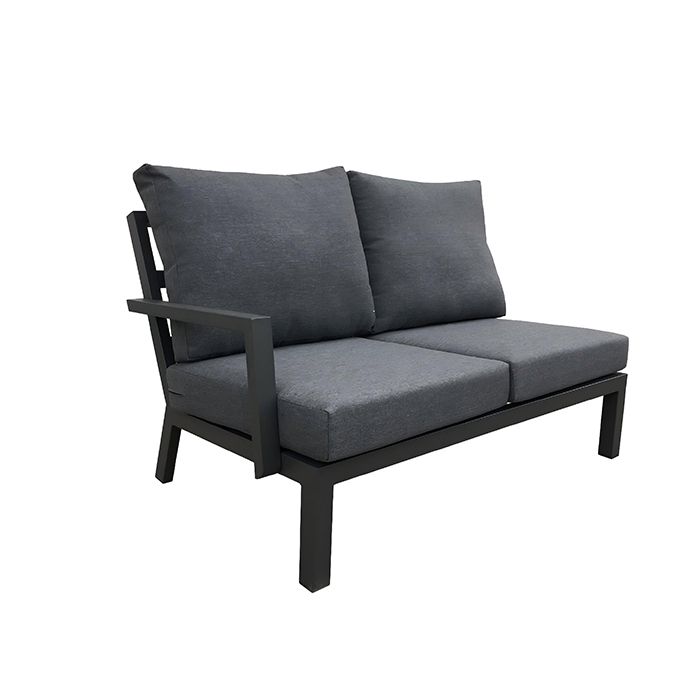
Comparing fixed frameworks against modular designs is crucial. A single-piece outdoor lounge sofa offers massive structural stability. It resists sliding on smooth pavers. It rarely shifts during daily use. Conversely, a modular combination sofa set delivers unmatched adaptability. You can reconfigure pieces dynamically over time. You can split it apart for large parties. You can push it together for family movie nights.
Table: Matching Shape to Function
Layout Shape
Best Suited For
Footprint Impact
L-Shaped Sectionals
Corner placements, defining open-concept deck boundaries.
Efficiently utilizes perimeter space while keeping the center open.
U-Shaped Arrangements
Fire pit layouts, high-capacity entertaining scenarios.
Requires significant central floor space and wide access paths.
Linear Sofas + Club Chairs
Narrow balconies, formal symmetrical aesthetics.
Keeps traffic flowing linearly without trapping guests.
Seat depth heavily impacts ergonomics and spatial requirements. We must differentiate upright seating from deep-seating designs. Upright seating promotes casual dining and active conversation. It requires less overall deck space. Deep-seating designs mimic luxury resort lounging. They encourage leaning back and relaxing. However, deeper frames consume significantly more floor space. Check the overall depth specifications carefully. Some luxury deep-seating units easily exceed 40 inches. They will quickly overwhelm a narrow balcony.
Assessing Material Durability and Maintenance Realities
Marketing claims often confuse buyers. We must evaluate actual frame engineering instead. Strip away flashy promotional terms. Analyze the core structural materials honestly.
Summary Chart: Material Durability Profile
Material Type
Weight Profile
Weather Resistance
Maintenance Demands
Powder-Coated Aluminum
Lightweight, easy to rearrange.
Rust-proof, highly resilient.
Low. Requires gentle washing only.
Solid Teak Wood
Heavy, highly wind-resistant.
Prevents rot, lasts decades.
High. Requires annual oiling for color.
HDPE Wicker
Moderate weight.
Resists fading and unravelling.
Low. Requires brushing off dust.
Cushions often fail much faster than frames outdoors. Frame your evaluation strictly around water resistance versus water repellency. Repellency means water merely beads on the surface temporarily. Resistance implies surviving prolonged downpours. High-UV areas demand solution-dyed acrylics. The industry widely accepts Sunbrella as a gold standard here. The manufacturer dyes the acrylic fibers completely through. They resist fading significantly better than cheap surface-printed fabrics.
Furthermore, highlight the internal foam construction. You must require reticulated foam cores. This open-cell structure allows rapid water drainage. It effectively prevents dangerous internal mold growth after rainstorms.
Maintenance trade-offs exist everywhere. Set transparent expectations early. A high-end patio sofa set still demands routine care. It requires seasonal cleaning to remove sticky pollen. Winterization is absolutely necessary in colder climates. Specialized protective covers remain mandatory. They help the furniture reach its expected 10-year lifespan.
Anchoring the Layout with Focal Points
Establishing a center of gravity prevents a chaotic visual layout. You must design the layout around one primary feature. This feature dictates your entire spatial geometry.
Follow these distinct steps to anchor your arrangement properly:
Identify your primary backyard focal point (e.g., a scenic view or a built-in fire pit).
Align the largest seating unit directly facing this focal point.
Position secondary chairs to close the conversational circle naturally.
Center the entire furniture grouping over a suitably sized outdoor rug.
We must emphasize the vital role of the outdoor rug. It visually glues the garden lounge furniture together. It transforms scattered pieces into a cohesive outdoor room. Follow a strict rule of thumb here. At least the front two legs of the sofa set must rest completely on the rug.
Do not forget lighting and accessory integration. Allocate specific spatial allowances for large accessories. Cantilever umbrellas require massive, weighted bases. Side tables need strategic positioning near armrests. Pathway lighting guides your guests safely at night. Keep these accessories far away from primary ingress and egress routes.
Implementation Risks: Delivery, Assembly, and Storage
Address the harsh reality of surface leveling immediately. Very few outdoor surfaces sit perfectly flat. Concrete patios intentionally slope away from the house. This standard slope prevents water pooling near your foundation. Uneven pavers shift over several years. Soft grass causes heavy furniture legs to sink. We strongly recommend buying frames equipped with adjustable leveling feet. They stabilize the unit instantly on sloped surfaces.
Delivery and assembly often cause massive buyer friction. Large modular sets rarely arrive in small parcels. They usually arrive via freight delivery. The carrier drops massive cartons onto your driveway. You must measure your exterior gates beforehand. Measure enclosed patio doorways meticulously. Buyers frequently struggle to move massive cartons through narrow garden gates.
Off-season logistics demand serious attention before purchasing. Force yourself to evaluate winter storage capacity right now. A massive U-shaped arrangement consumes significant garage space. You may lack sufficient indoor storage completely. Introduce heavy-duty protective covers immediately. Treat them as a mandatory secondary purchase, not an optional accessory. Covers block ice, snow, and rodent damage during harsh winters.
Conclusion
Let us summarize the shortlisting logic carefully. First, measure your active usable footprint precisely. Next, select a layout geometry matching your primary entertainment style. Filter those seating options by climate-appropriate materials. Finally, plan logistics for freight delivery and off-season storage.
Prompt yourself to take a next-step action today. Grab a roll of painter's tape immediately. Physically tape out your available space this afternoon. Audit your local weather patterns closely. This finalizes your material requirements confidently. You are now ready to build a stunning, durable outdoor room.
FAQ
Q: How much space do I need for an outdoor lounge sofa set?
A: You need a minimum 10x10 foot footprint for a standard three-piece arrangement. This specific sizing comfortably accommodates the seating units. It also accounts for essential 36-inch perimeter walkways. Deep-seating models demand even larger footprints. Always map out the physical dimensions with tape before ordering.
Q: Can a patio sofa set be left outside in the rain?
A: Yes, you can leave high-quality pieces outside. However, they must feature reticulated foam cores and marine-grade fabrics. These materials allow water to drain rapidly. We still require protective covers for heavy storms. Covers drastically extend the overall lifespan. They also reduce your weekly cleaning time significantly.
Q: What is the advantage of a modular combination sofa set?
A: Modular designs provide exceptional scalability and layout adaptability. You can effortlessly split a large L-shape into separate conversational zones for big parties. You can add extra armless chairs later as your family grows. This flexibility prevents you from outgrowing your initial furniture investment.
Q: How do I keep my garden lounge furniture from blowing away?
A: Hollow aluminum and lightweight wicker struggle against high winds. Dense teak and wrought iron naturally resist shifting. If you choose lighter modular pieces, you must secure them properly. Use heavy-duty furniture clips to lock sections together. You can also purchase weighted bases or sandbags for extreme weather conditions.