- Home

How To Use Expandable Dining Tables For Flexible Outdoor Meals
Views: 0 Author: Site Editor Publish Time: 2026-06-18 Origin: Site


Homeowners frequently over-invest in massive outdoor tables for occasional gatherings. This common mistake severely wastes daily patio space. Conversely, others under-invest and consistently lack seating capacity for hosting larger groups. Finding the right balance often feels impossible for many hosts. An expandable outdoor dining table easily bridges this gap. It shifts effortlessly between daily family use and peak hosting events. This smart transition entirely eliminates the need for wobbly secondary folding furniture.
This comprehensive guide breaks down exactly how to evaluate different extension mechanisms. We also cover selecting optimal weather-grade materials and mapping out patio spatial configurations. You will learn how to finalize your outdoor furniture decision with total confidence. Knowing your precise options allows you to build a highly functional, welcoming backyard environment. Read on to discover the specific steps for choosing, placing, and maintaining your ideal dining setup.
Key Takeaways
Sizing flexibility: Calculate necessary patio clearance for both the collapsed and fully extended states (minimum 36 inches from the table edge).
Mechanism reliability: Choose extension hardware based on climate; butterfly leaves offer convenience but require rust-proof hinges, while drop-in leaves eliminate moving parts.
Material stability: Prioritize materials that resist thermal expansion and warping, such as powder-coated aluminum or premium teak, to prevent track jamming.
Seating logistics: Pair your table with stackable or folding chairs that can be easily stored when the table is collapsed.
Evaluating Your "Peak vs. Baseline" Entertaining Needs
You must start by understanding your actual usage patterns. Many consumers buy patio furniture for an imagined, highly social lifestyle. We highly recommend designing your space for reality instead. You can achieve this by strictly defining your baseline and your peak usage.
Baseline assessment: Define your daily or weekly seating requirement. A family of four usually requires a footprint scaled strictly for four to six people. This baseline number dictates your ideal collapsed table size. A smaller daily footprint keeps your patio open, visually clean, and easily navigable during normal routines.
Peak capacity modeling: Identify the absolute maximum number of guests you host three or more times a year. Do you regularly host Thanksgiving outdoors? Do you throw large summer barbecues for twelve neighbors? Find this specific maximum number. This figure dictates the required fully extended length you must shop for.
Success criteria mapping: Compare the two numbers. The right expandable outdoor table minimizes your daily spatial footprint. At the same time, it gracefully accommodates peak events. You should never need to haul out secondary plastic tables. The primary unit must handle both extremes securely.
Failing to conduct this evaluation often leads to buyers purchasing tables that look beautiful but function poorly. Always build your shopping parameters around these concrete seating numbers.
Comparing Extension Mechanisms in an Expandable Outdoor Dining Table
The internal mechanics of your table determine its overall lifespan. You must understand how different leaves operate before purchasing. Each mechanism behaves differently under harsh environmental stress.
Mechanism Type
Operation Style
Storage Need
Best Climate
Butterfly Leaf
Folds and rotates under table
None (Self-storing)
Dry / Mild
Drop-In Leaf
Manual lift and placement
High (Garage/Shed)
Humid / Coastal
Sliding Tracks
Top slats pull outward
Varies by design
All-weather (if polymer)
Self-Storing Butterfly Leaf
How it works: The central leaf folds precisely in half. It then rotates backward to hide completely beneath the main table surface.
Pros: You get ultimate convenience. You never need separate garage space for the extra wooden piece. One person can usually flip it open quickly.
Risks: This mechanism involves many moving parts. Hinges and swivels remain highly susceptible to moisture. They might seize or rust rapidly in humid coastal environments if you ignore regular maintenance.
Removable / Drop-In Leaf
How it works: You pull the table ends apart manually. Then, you place a separate, heavy leaf straight into the open center gap.
Pros: This design proves extremely durable. It entirely lacks complex folding hardware beneath the surface. Fewer delicate parts mean fewer potential mechanical failures over the years.
Risks: You must have dedicated, dry storage space. The leaf requires a safe spot in a garage or shed. If you store a wooden leaf in a damp basement, it will warp. A warped leaf will never fit back into the table properly.
Sliding / Stretchable Dining Table Tracks
How it works: The table legs often remain stationary. Meanwhile, the top slats slide smoothly outward to expand the usable surface.
Evaluation lens: You must carefully inspect the track construction of any stretchable dining table. Ensure the gliding components utilize high-density polymer or rust-proof bearings. Cheap metal tracks will corrode. This corrosion causes a permanent friction lock over time.
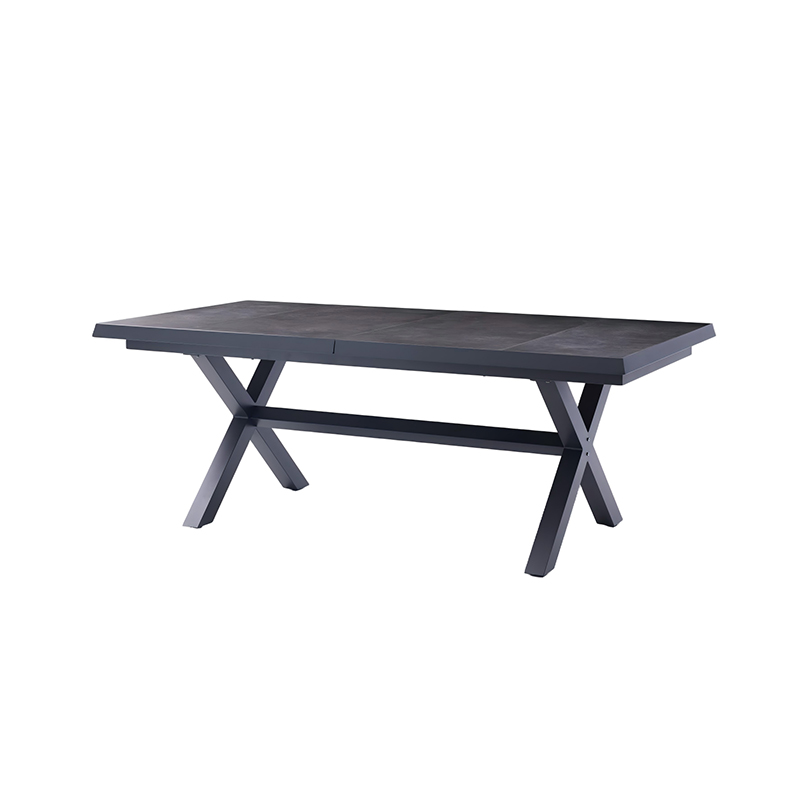
Material Selection for an Outdoor Extension Table
Selecting the right structural material remains critical. An outdoor extension table faces intense daily environmental stress. Sun, freezing rain, and rapid temperature shifts heavily impact the sensitive moving parts.
Powder-Coated Aluminum
Best for: Lightweight maneuverability and modern design aesthetics. A single person can usually operate the aluminum extension mechanism without any assistance.
Durability profile: Aluminum remains inherently rust-proof. The intensive powder-coating process adds a tough, scratch-resistant barrier. More importantly, aluminum is immune to moisture warping. This structural stability ensures your extension tracks remain perfectly aligned year-round. It requires almost zero heavy upkeep.
Grade-A Teak
Best for: Heavy-duty weight stability and premium, timeless visual appeal. Teak feels substantial and luxurious.
Implementation reality: All wood naturally expands and contracts based on ambient moisture levels. Cheaper woods often warp noticeably after one rainy season. This warping causes delicate extension tracks to jam entirely. High-grade teak minimizes this severe risk due to its dense natural oils. Still, you must perform seasonal hardware checks to ensure smooth mechanical operation.
Hardware Evaluation
Tabletop material only tells half the story. You must explicitly confirm the metal grade of all underlying structural components. Check the hidden hinges, locking pins, and track screws. They must be forged strictly from 304 or 316 marine-grade stainless steel. Standard steel hardware will inevitably rust. Rust expands, causing complete mechanical failure in the track systems.
Space Planning: Sizing Your Expandable Outdoor Table
An expandable outdoor table requires thoughtful, precise spatial mapping. You must account for its largest possible physical size before buying.
Patio Activity
Required Minimum Clearance
Pushing chair back to stand up
36 inches from table edge
Walking behind seated guests
48 inches from table edge
Proximity to active BBQ grill
60 inches (Safety buffer)
The 36-Inch Clearance Rule
Always measure your available patio area first. Subtract 72 inches (which accounts for 36 inches per side) from both the total length and width. This calculation reveals your maximum allowable fully extended table dimensions. Guests absolutely need this 36-inch buffer. It allows them to push back chairs and walk comfortably behind other seated diners without falling off the deck.
Mapping the Footprint
We highly recommend using painter's tape to mark the patio directly.
Tape out the table dimensions in its collapsed state first. Walk around this square or rectangle. Visualize your daily foot traffic flow.
Next, tape out the exact dimensions in its extended state. Verify the expanded table does not block sliding doors, deck steps, or hot outdoor grills.
Leg Placement Considerations
Carefully observe how the table physically expands. Some tables keep their heavy legs stationary at the corners, simply pulling the top apart. Others feature legs that move outward along with the ends. Tables where the legs move outward offer vastly superior legroom. This smart design prevents guests seated at the leaf seams from constantly knocking their knees against thick table posts.
Building a Cohesive Patio Dining Set (Seating Logistics)
Your seating choices must be just as flexible as the table itself. A truly functional patio dining set requires a strategic mix of fixed and temporary elements.
Primary vs. Secondary Seating
Use substantial, permanent armchairs for your baseline seating configuration. These primary chairs stay out year-round. They provide deep, supportive comfort for everyday family meals. They anchor the visual look of the space.
Storing Extra Capacity
You need a solid plan for peak hosting days. Invest in matching stackable chairs. Alternatively, source high-quality outdoor folding chairs. You deploy these secondary chairs only for the supplementary spots created when the table expands. Ensure these secondary chairs utilize quick-dry sling fabric. This prevents you from needing to store bulky cushions alongside the folded chairs.
The Bench Strategy
Consider placing a sturdy outdoor bench on one side of the table. Benches offer incredible seating versatility. A single long bench can easily seat three people when the table is fully extended. When you collapse the table back down, the bench slides effortlessly underneath. It vanishes completely from the walkway, saving massive amounts of space.
Implementation Realities and Maintenance Requirements
Outdoor mechanical systems demand specific care routines. You must actively protect the moving parts from nature to ensure longevity.
Track Lubrication
Apply a dry silicone spray directly to aluminum or polymer extension tracks. You should perform this maintenance task twice a year. We strongly advise you to avoid oil-based lubricants like standard WD-40. Thick oil immediately attracts blowing grit, pollen, and dirt. This creates a sludgy paste that eventually destroys the glide mechanism. Dry silicone maintains smooth, effortless operation without attracting debris.
Protective Covers
Always buy a custom-fit cover based strictly on the collapsed table size. Your furniture should spend 80% of its life in the retracted position anyway. Covering it diligently protects the sensitive interior mechanisms. It prevents standing rainwater from pooling inside the leaf seams, which often leads to hidden corrosion.
Clearing Debris
Always wipe the table seams thoroughly before pushing the table back together. Pine needles, grit, or dirt easily get caught in the central gap during outdoor meals. Crushing hardened debris into the seam will permanently dent the edges. It can also severely misalign the internal locking pins, making future extensions impossible.
Conclusion
Choosing the right expandable furniture fundamentally transforms how you utilize your backyard space. Always prioritize mechanism reliability and weather-appropriate material composition over pure visual aesthetics. An elegant table is useless if the extension tracks freeze solid after one winter.
We recommend you measure your patio space meticulously for both collapsed and extended states. Explicitly verify the inclusion of marine-grade stainless steel hardware in the spec sheet. Finally, ensure you possess a viable, dry storage plan for any removable leaves or extra secondary chairs. Following these specific steps guarantees you will build a welcoming, highly adaptable dining space ready for any occasion.
FAQ
Q: Do the mechanisms on expandable outdoor tables rust over time?
A: If the manufacturer uses standard steel hardware, yes. For outdoor use, ensure the table’s internal tracks, hinges, and locking pins are strictly made from 304/316 stainless steel or aluminum. These materials resist rust significantly better, ensuring the mechanism continues to glide smoothly over years of exposure.
Q: Can one person expand an outdoor dining table alone?
A: This depends on the material. Aluminum tables with synchronized glides can typically be opened by one person. Solid teak tables are significantly heavier and usually require two people to pull the ends apart safely without straining the underlying tracks.
Q: Should I leave my table extended all the time?
A: No. It is best practice to keep the table in its collapsed, locked state during harsh weather. This minimizes the exposed surface area and protects the vulnerable internal tracks and leaf seams from water pooling and debris accumulation.
Q: Do I need a special cover for an expandable table?
A: Buy a cover sized for the table's collapsed state. When the table is not in active use, it should be closed and covered to prolong the life of the finish and the mechanical parts. Storing it collapsed keeps the protective cover tight and secure.