- Home

Can 10 People Fit at A 72 Inch Round Table?
Views: 0 Author: Site Editor Publish Time: 2026-04-13 Origin: Site


When evaluating large-format dining furniture, you might hear one piece praised above all others. The 72-inch round table often claims the title of the ultimate gathering solution. You might wonder if you can actually fit ten people around it comfortably. The physical ability to squeeze chairs together does not guarantee an enjoyable dining experience. Planners often misjudge the spatial mathematics involved in seating this many guests. The functional reality depends heavily on chair dimensions, dining style, and tabletop real estate. For buyers considering a premium investment, understanding these constraints is essential before finalizing a floor plan. You will learn the exact spatial geometry behind seating capacity. We will also explore logistical considerations and aesthetic trade-offs. Ultimately, you will discover how to reliably execute a seating arrangement feeling intentional, premium, and spatially sound.
Key Takeaways
**The Mathematical Baseline:** A 72-inch round table has a circumference of roughly 226 inches, providing about 22.6 inches of edge space per person when seating 10 (slightly below the 24-inch luxury standard, but highly functional).
**Tabletop Real Estate:** Seating 10 adults severely limits the use of 13-inch charger plates, as silverware and glassware will overlap.
**Service Style Matters:** Buffet or minimalist menus comfortably accommodate 10-12 people; formal plated dinners or family-style service max out at 8-10.
**The Conversation Factor:** A 72-inch span creates an acoustic and physical barrier; guests will primarily interact with adjacent neighbors rather than cross-table.
**Logistical Risk:** Before purchasing, buyers must verify delivery access—72-inch solid tops frequently fail to clear standard residential doorways or tight hallway turns.
The Mathematics of Capacity: Circumference vs. Human Comfort
To make an informed purchasing decision, buyers must look past visual estimations. You must rely on spatial geometry instead. Placing chairs around a perimeter seems simple. Yet human comfort requires precise mathematical allowances.
We first examine the circumference formula. A 72-inch diameter creates about 226 inches of perimeter space. Divide this perimeter by 10 guests. You get 22.6 inches of linear edge space per person. Standard ergonomic guidelines recommend 24 to 30 inches per person for luxury dining. At first glance, 22.6 inches appears inadequate.
However, round tables create a unique "fanning out" effect. The circular shape naturally angles chairs outward. Guests sit slightly back from the table edge. This geometry creates wider shoulder room behind the physical perimeter. Because of this radial expansion, the 22.6-inch edge allowance becomes perfectly viable for ten adults. They can eat comfortably without feeling restricted.
You must heed the 12-guest warning. Pushing capacity to eleven or twelve people introduces severe problems. Per-person spacing drops below 19 inches. At this high density, guests cannot comfortably use a knife and fork. Elbow collisions occur constantly. Furthermore, you cannot push the chairs fully under the table when they are unoccupied. The chair seats will wedge against one another.
Capacity Breakdown Table
Guest Count
Linear Edge Per Person
Comfort Level
Best Use Case
8 Guests
28.2 inches
Spacious / Luxury
Formal fine dining, large armchairs
10 Guests
22.6 inches
Comfortable / Functional
Standard dinners, standard chairs
12 Guests
18.8 inches
Overcrowded / Restricted
Brief standing receptions only
Meal Style and Tabletop Real Estate (Aesthetics vs. Utility)
The density of your seating directly dictates your tabletop setup. You cannot separate seating capacity from your intended menu. High guest counts consume valuable tabletop real estate rapidly. You must map your solutions to your specific use case.
Consider the 13-inch charger collision. Real-world testing reveals a glaring issue for dense seating. Placing ten 13-inch charger plates on a 72-inch table leaves less than one inch of clearance between settings. Your silverware and water goblets are forced to overlap. This clutter degrades the premium feel of the event. Guests feel anxious navigating their own cutlery.
Different service models impose different constraints. You must align your guest count with how you serve the food.
Common Mistakes in Service Planning:
Ignoring glassware footprint. Multiple wine stems consume immense space.
Assuming bread plates will fit alongside chargers. They rarely do at a ten-person capacity.
Forgetting water pitchers and condiment placement.
Service Style Seating Chart
Service Style
Max Capacity
Reasoning
Plated / Formal
8 to 10
Requires space for full flatware settings and multiple glassware stems.
Family Style
8 (Strict Max 10)
Demands a massive central footprint for shared serving platters.
Buffet
10 to 12
Food is kept off the table. Place settings remain minimal.
Centerpiece proportions also demand strict attention. A dense ten-person arrangement severely limits aesthetic choices. You must use low, wide centerpieces. Keep floral arrangements under 12 inches tall. This prevents visual clutter. It also preserves the crucial line-of-sight across the remaining gaps between guests.
Residential Dining vs. Event Venues: Space Planning Realities
A table succeeding in an open banquet hall may easily suffocate a residential dining room. Space planning requires looking beyond the furniture piece itself. You must evaluate the surrounding traffic flow.
High-end residential setups follow the 36-inch clearance rule. You must maintain a minimum of 36 inches of hard clearance around the entire perimeter. Guests need this space to slide their chairs out without hitting walls. Service members need this space to walk behind seated diners safely.
You can calculate your room fit using these structured steps:
Measure your total room length and width in inches.
Subtract 72 inches from both dimensions to account for the table footprint.
Divide the remaining space by two. This gives you your exact wall-to-table border.
Verify this final number exceeds 36 inches on all sides.
Based on these calculations, the absolute minimum room size is 12 by 12 feet. However, a 12-foot room feels extremely tight once guests arrive. Planners strongly recommend a 14 by 14 foot space. This larger dimension ensures a truly comfortable traffic flow.
Commercial event floorplans operate under different logic. Banquet halls host dozens of tables simultaneously. Industry standards dictate leaving 54 inches between table centers. This exact spacing accounts for back-to-back chairs. It also leaves a functional 24-inch service aisle for catering staff to navigate.
Hidden Implementation Risks: Chair Width and Access Needs
Pre-purchase evaluations often overlook critical supporting elements. Buyers focus entirely on the table size. They forget the variables dictating whether the piece will actually function in situ. Chair architecture and logistical access are frequent blind spots.
Chair architecture directly impacts capacity. Squeezing ten people requires narrow, armless seating. Standard Chiavari chairs or slim parsons chairs work perfectly. Their slender profiles align well with tight edge allowances. Upgrading to wider profile seating changes the math entirely. Wishbone chairs or wide armchairs consume massive lateral space. Introducing these designs immediately reduces your safe capacity to eight guests.
The access and delivery check is another major hurdle. A 72-inch round table top is a massive, rigid plane. Many solid tops do not feature center leaf splits. Buyers must measure their entire delivery route carefully. You need to verify doorway heights, stairwell turn radiuses, and elevator dimensions. Failure to map this route causes the highest number of return requests for large dining tables.
Best Practices for Delivery Prep:
Create a cardboard template matching the table diameter.
Walk the template through your front door and hallways.
Check tight corners for pivot clearance.
Finally, consider accessibility and reach. Reaching the center is physically difficult at six feet across. Guests cannot comfortably pass salt or butter across this expanse. For residential use, integrating a Lazy Susan is a near-mandatory functional requirement. It bridges the gap between grand aesthetics and daily utility.
Evaluating the Aether Round Table for 10-Guest Configurations
Applying these frameworks to a premium product reveals vital insights. Intelligent design directly impacts total cost of ownership and daily usability. The Aether Round Table serves as an excellent case study in managing high-capacity dining.
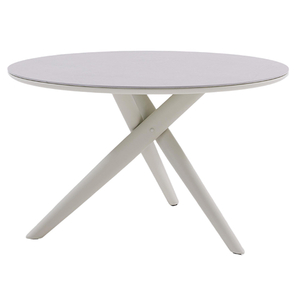
Base design heavily influences legroom. Traditional four-leg tables create awkward "dead zones". Chairs placed near the legs cannot be pushed in. Guests seated at these spots suffer restricted legroom. The Aether Round Table eliminates this issue entirely. It utilizes an optimized central pedestal architecture. This refined base allows for fluid, 360-degree seating. The ten-person configuration becomes vastly more comfortable without outer legs obstructing movement.
Edge profile design further maximizes utility. Standard tables often feature deep bevels or decorative drop-offs. These details steal crucial inches from the dining surface. The precise edge detailing of this premium table maximizes usable surface area. Plates sit perfectly flat right up to the perimeter. Every fraction of an inch counts when hosting ten adults.
Material durability ensures a strong return on investment. High-density settings subject tables to intense wear. Belt buckles, chair backs, and heavy spill volumes degrade inferior finishes rapidly. Premium material composition resists this accelerated wear. Your investment survives the rigors of max-capacity use while maintaining an elegant presentation.
Conclusion
Seating ten people at a 72-inch round table is not just mathematically possible. It represents the industry sweet spot for balancing capacity and comfort. You must simply manage the surrounding variables effectively. Ensure you pair the table with appropriate chair profiles. Acknowledge your chosen service style before finalizing the guest count.
Aggressively cap your list at eight guests if using formal 13-inch chargers or wide armchairs.
Verify your room offers at least 36 inches of clearance around the entire table.
Measure your delivery route thoroughly to avoid installation day disasters.
Choose pedestal base designs over four-leg models to maximize continuous legroom.
By leveraging intelligent base architectures, verifying room clearance, and mapping your delivery route, you guarantee success. You can reliably execute a ten-person seating arrangement that feels intentional, premium, and spatially sound.
FAQ
Q: Can you fit 12 people at a 72-inch round table?
A: Technically yes, but it is strictly advised against for formal dining. 12 people reduces individual space to under 19 inches, causing elbow collisions and making it impossible to push all chairs in simultaneously. It is only suitable for brief, casual seating with narrow chairs.
Q: What size rug do I need for a 72-inch round table?
A: You need a rug with a minimum diameter of 10 feet (120 inches). This ensures that when guests push their chairs back to stand up, the back legs remain on the rug rather than catching on the edge.
Q: Is a 72-inch round table too big for a conversation?
A: Yes, across the center. At 6 feet wide, cross-table conversation requires elevated voices and is largely ineffective in noisy rooms. Guests will naturally default to speaking with the two or three people immediately adjacent to them.
Q: How much room do you need between 72-inch round tables?
A: In an event or commercial layout, you must leave a minimum of 54 inches from the edge of one table to the edge of the next to allow for chairs and a safe passing aisle for service staff.
Table of Content list